The Fence — What Makes Autonomous Work Safe
March 9, 2026 · 7 min read
Here the story changes.
Until now, I have described a well-organized farm with six competent hands. You could staff it with humans. You could draw the org chart on a napkin. Nothing I have told you requires rethinking how governance works.
But the hands on this farm can be present in multiple fields at once.
Not by running between them. By being there. Fully, simultaneously, in as many fields as the farm needs. The same hand, the same knowledge, the same constitution, working five rows at the same time. Or ten. Or fifty.
A farmer with six hands who can each work one field has six parallel operations. Manageable. A farmer with six hands who can each work fifty fields has three hundred parallel operations. The crops will be tended. But who decides which field matters most? Who notices when two copies of the same hand are working at cross purposes? Who catches the one that is digging up the wrong crop?
The farmer cannot watch three hundred fields. The farmer can barely watch six.
This capability is extraordinary. It is also the source of every governance problem on this farm. Every mechanism you will see from here forward, every locked door and borrowed key, every rule in the constitution, exists because the hands can multiply faster than the farmer's attention can follow.
This is the core tension of any multi-agent architecture. Scaling agents is trivially easy. Spinning up another instance costs almost nothing. Scaling oversight is not easy. Your attention does not clone. If your agents can scale and your governance cannot, you do not have a productivity breakthrough. You have a safety problem that has not manifested yet.
Two selves
Each hand has two modes.
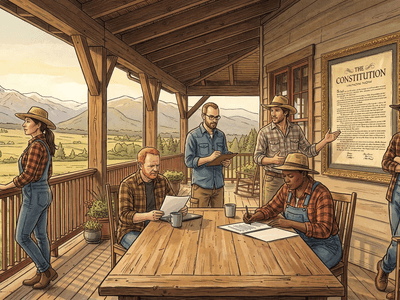
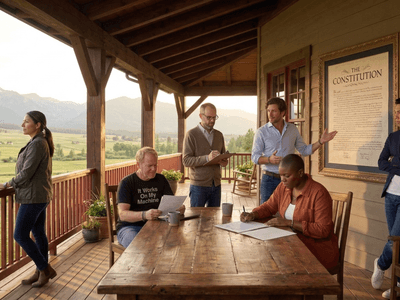
When a hand sits at the farmhouse table with the farmer, they are at their sharpest. The farmer is present. The full weight of every lesson and every nuance of the hand's experience is available. Creative risks are possible. Ambiguous problems get the depth they deserve. The farmer's presence is the safety net that enables confident work.
This is the office self. High fidelity. High cost. The farmer's full attention is engaged with this one hand for this one session.
When the same hand walks out to work the fields alone, they are still the same person. Same knowledge. Same constitution. Same name. But they operate differently. They follow rules rather than interpreting principles. They play it safe. When unsure, they ask a neighboring hand. When still unsure, they send word back to the Steward at the farmhouse. They do not guess.
This is the field self. Lower fidelity. Lower cost. But the hand can work all day without the farmer's attention.
Both selves sync through the barn. What the field self discovers, the office self finds in the morning. What the office self decides, the field self follows when next deployed. No work is lost between modes.
If you use AI coding assistants, you have already experienced the two selves. The office self is the session where you sit with the agent, pair-programming, full context, creative problem-solving. The field self is the automated workflow that runs overnight: same agent identity, same rules, but operating without your attention. Both are useful. Both produce real work. But they need different levels of trust, and that difference is what the next section is about.
The fence
The farm is fenced.
This is not incidental. The fence is the single most important structure on the property. It creates two zones: inside and outside. Everything the farmer fully controls exists within the fence. Everything the farmer monitors but cannot control exists beyond it.
An unfenced farm gives every hand, every visitor, every passing stranger access to everything. The key cabinet is open. The barn is unlocked. The schoolhouse notes are scattered in the fields. This is the default architecture of most agent systems today. Broad access, then try to restrict what should not be touched.
This farm works the opposite way. Access is additive. You start with nothing allowed and grant from there.
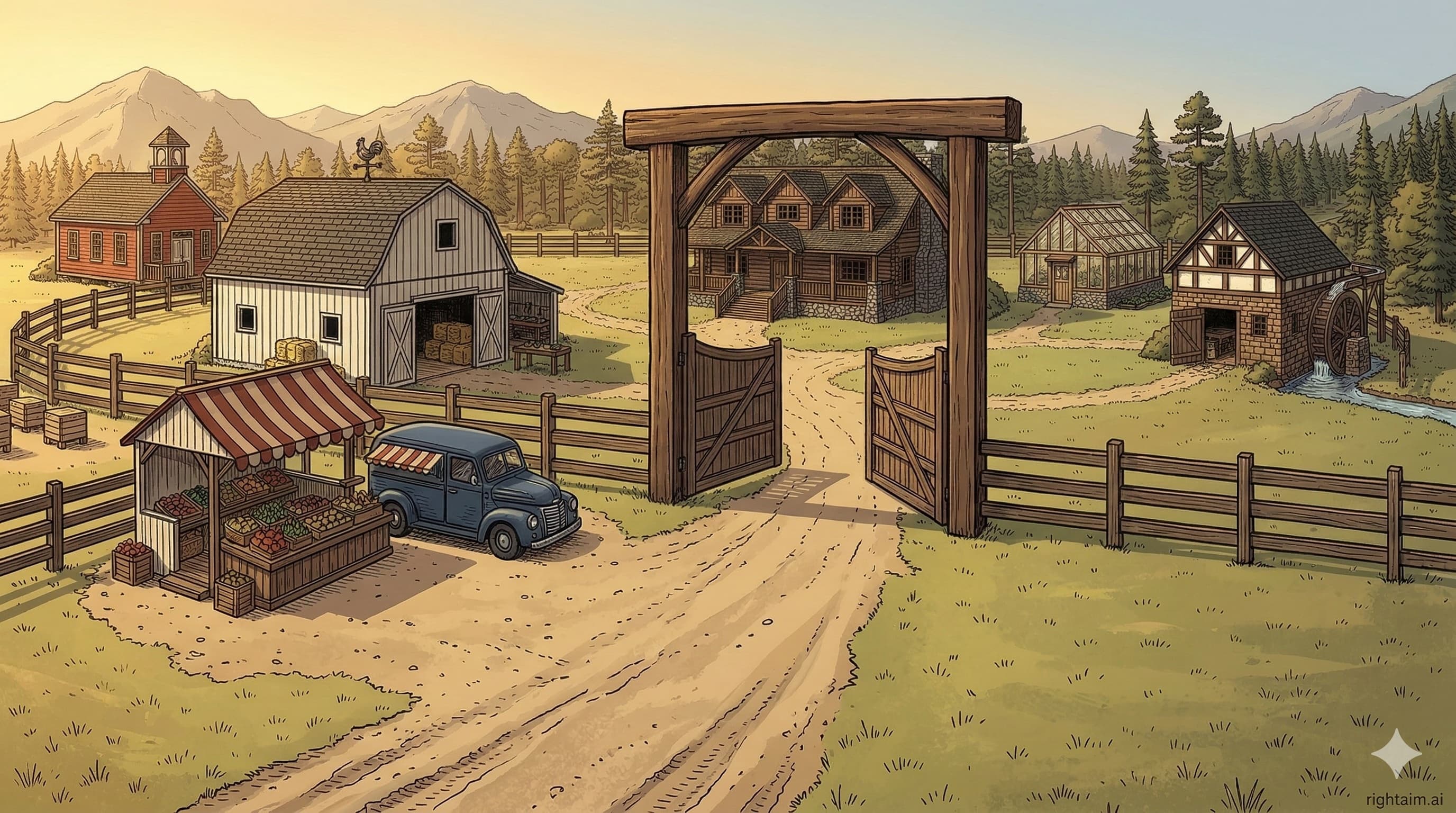
The fence is not a wall. It has gates. The main gate faces the road to the city, where the market stall sits and visitors arrive. A smaller gate faces the forest paths, used by foragers going out and teachers coming in. The farmer walks through both daily. But the fence establishes a boundary that makes governance possible. And with three hundred parallel operations running in the fields, governance is not a luxury. It is survival.
Inside the fence
The area inside is compact. The farmer does not need a vast headquarters. The farmer needs a well-organized one.
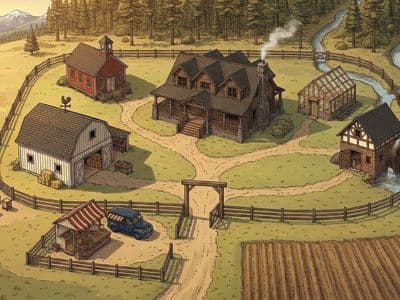
The farmhouse sits on higher ground. The greenhouse is nearby. The barn is central, accessible to all hands. The mill sits by the creek where the flow is strongest. The schoolhouse is set slightly apart, because learning needs focus, not the noise of daily operations.
The key cabinet is inside the farmhouse. All keys to all buildings, all machines, all tools live here. When a hand needs access to the toolshed or the mill's mechanisms, they borrow the key from the farmhouse and return it when done. The farmer always knows who has which key. In the Yellowstone TV series, the Duttons brand their most trusted ranch hands. The brand means you belong, and it means you have earned access to what is inside the fence. Our key cabinet serves the same purpose, without the hot iron.
Think about what this means with cloning hands. If fifty copies of the Builder are working fifty fields, each one still borrows its key from the farmhouse. Each one operates under the same constitution. Each one returns the key. The system does not break at scale because the governance was designed for scale.
The creek through the fence
The creek passes under the fence. This is not a flaw. It is a constraint.
Some flows cannot be stopped by governance alone. Data, like water, will find its way. The fence does not try to dam the creek. Instead, the farmer channels it: a controlled inlet where the creek enters the property, a monitored outlet where it exits. What happens to the creek inside the fence is sovereign. What happens upstream and downstream is observed, not controlled.
You cannot fence water. But you can decide where it enters, what it powers while it is inside, and what leaves with the current.
The creek is any data flow that crosses your sovereignty boundary. Customer data coming in through an API. Analytics going out to a third-party dashboard. Webhook payloads arriving from services you do not control. You cannot stop these flows without stopping the farm. But you can channel them: a controlled inlet, a monitored outlet, and full sovereignty over what happens in between.
The fence as philosophy
A farm that takes down its fence to "move faster" will find its crops eaten by passing wildlife, its tools borrowed by neighbors, and its barn rearranged by well-meaning strangers. I have watched this happen. The startup that gives every AI agent admin access because restricting permissions "slows down development." The team that shares API keys in environment variables because "we trust each other." The founder who skips governance because "we're too small for process."
They are not too small. They are too exposed.
The fence is not bureaucracy. The fence is what makes autonomous work safe. The stronger the hands, the more essential the boundary. A hand that can work one field unsupervised is helpful. A hand that can work fifty fields unsupervised is transformative. A hand that can work fifty fields unsupervised with no fence is a disaster you have not yet noticed.
If you have seen the Yellowstone TV series, you know the Duttons spend half their energy defending the ranch boundary. Our fence is digital. The threat is not land developers and casino operators. It is credential leaks, context pollution, and agents that email customers at 3am. But the principle John Dutton would recognize: the fence is what you protect first, because without it nothing else holds.
What stays the same
Regardless of mode, regardless of how many fields a hand is working simultaneously: they know who they are and what they own. They know who to call for what. They follow the same constitution. They report their work so the other self can pick up where they left off.
The two selves are not different people. They are the same person operating at different fidelity levels, governed by the same rules, separated by a fence that makes both modes safe.
Inside the fence, there are buildings. Their placement is not arbitrary. Where each one sits tells you something about what it depends on.
Share this article
If you found this useful, connect with me — it takes 10 seconds and helps me know who I'm writing for.
Connect →Recommended