The People — Six Hands, One Farmer
March 11, 2026 · 7 min read

The bell rings at seven.
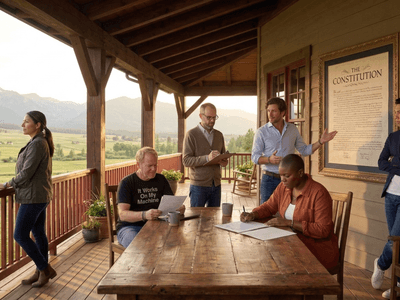
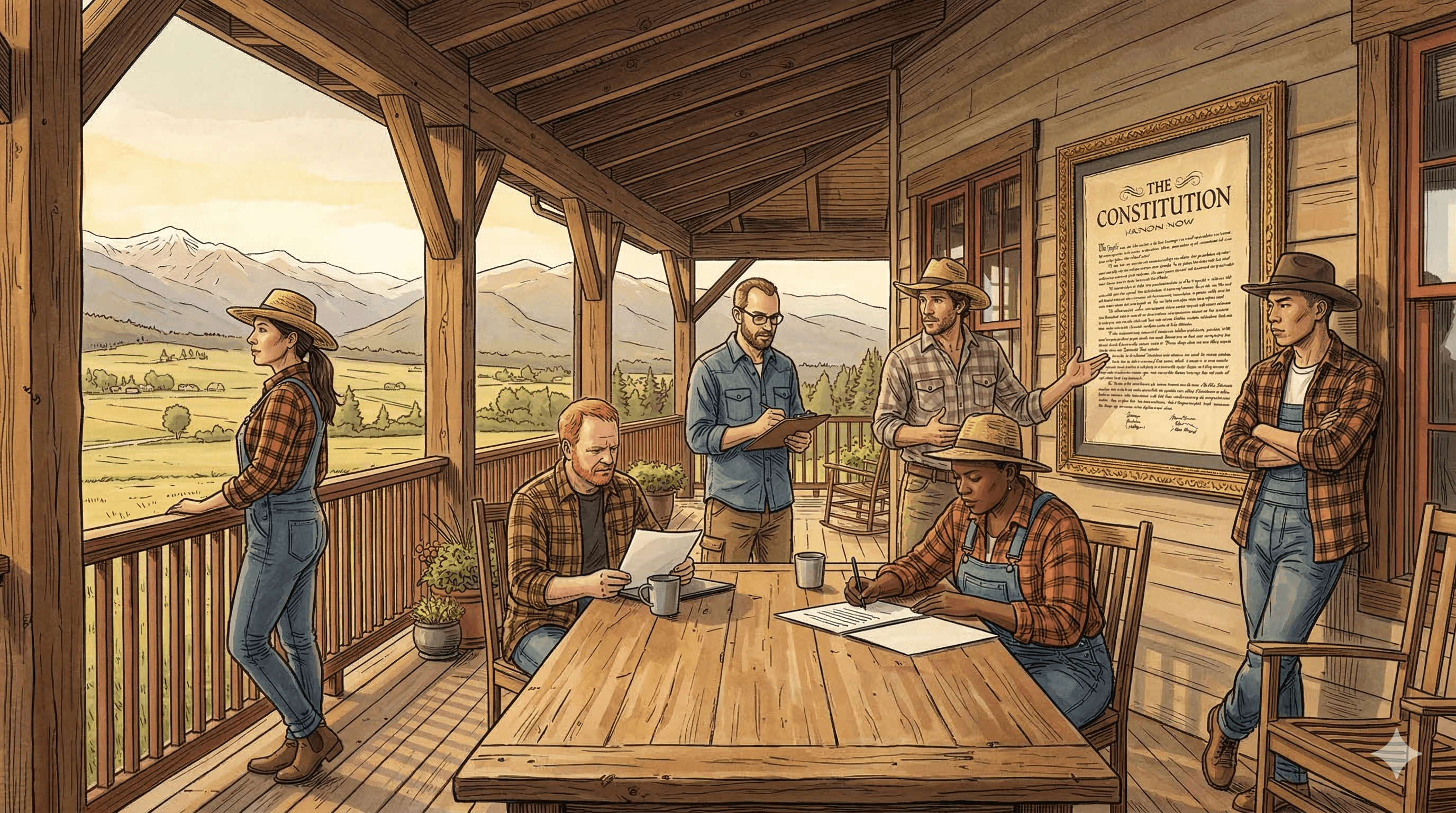
It hangs above the farmhouse porch, mounted where it catches the morning wind. When it rings, the hands stop what they are doing and walk toward the house. Not running. Nobody runs on this farm unless something is on fire. They come at their own pace, from the greenhouse, from the barn, from the fields, and they gather on the porch where the farmer is already sitting with coffee and a chalkboard.
This is the standup. If you have watched the Yellowstone TV series, you have seen John Dutton do a version of this on his porch, coffee in hand, surveying who is where and what needs doing. Our farmer does the same. Each hand says what they did yesterday, what they plan to do today, and what is in their way. The farmer asks one or two questions. The Steward takes notes. It is over in ten minutes. Then the hands leave, and the farmer sits alone with the chalkboard.
The farmer is the main character of this story. If you are reading this as an executive, a technical leader, or someone exploring the idea of running a team of AI associates, the farmer is you. The farm is your operation. The hands are the agents you are considering hiring, and the decisions the farmer makes about how to organize them are the decisions you will face.
The farmer has a problem.
The problem
The farmer's scarcest resource is not money. Not land. Not time in some abstract sense. It is attention. The cognitive capacity to look at the chalkboard after the standup and decide, right now, what matters most. Every interruption costs more than the interruption itself. It costs the decision that did not get made while the farmer was handling something a hand could have handled alone.
A farm where the farmer touches every decision is a farm where the farmer is the constraint. Not the bottleneck. The constraint. Bottlenecks can be widened. The farmer's attention cannot. It is a fixed resource. One unit per day. It does not roll over.
So the question that governs everything on this property is: how do you get the most from your people while spending the least possible attention from one finite farmer?
The answer starts with who those people are.
I learned this the hard way. My first instinct was to give every agent access to everything and let capability sort it out. It took about forty-eight hours to realize that the problem is never what your agents can do. The problem is what they do when you are not looking. The entire architecture I am about to show you is a response to that realization.
Morning rounds
After the standup, the farmer walks the property. Not every morning. But often enough to read the farm with their own eyes instead of through the dashboard upstairs.
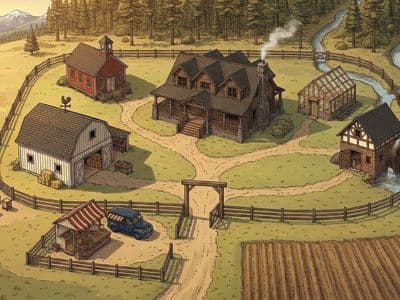
The first stop is the greenhouse, because that is where the most fragile things live. The Builder is already inside, checking seedlings in labeled rows. Some are just sprouting. A few trays sit empty, cleared away with a note about what went wrong. That note matters. It goes to the schoolhouse, where it becomes a lesson for every hand on the farm. A failed seedling is not waste. It is tuition. The Builder is unsentimental about failure. Does it grow? Does it respond to tending? Will anyone actually pay for what it produces? If the answer is no, the tray gets reused and the next seed goes in. The Builder does not fall in love with things that will not ship.
The farmer and the Builder talk about one seedling in particular. It looks ready for the field. The Builder thinks so too, but wants the Groundskeeper's read on field conditions first. The farmer nods. That is how it should work. Two hands finding common ground before asking the farmer to weigh in.
The barn is next. The Bookkeeper is already at the ledger. Incoming harvest deliveries on one side, outgoing shipments on the other, and a backlog of materials in between that tells its own story. The Bookkeeper does not interpret. They record. What came in. What went out. What it weighed. The separation of data from meaning is deliberate. The Bookkeeper provides the number. What the number means is the farmer's problem.
This morning the number says the barn is getting full. That means something downstream is not keeping pace with something upstream. The farmer makes a mental note.
Out in the fields, the Groundskeeper is walking rows. Every ranch has a Kayce Dutton. The quietest hand on the farm, and proud of it. Success for the Groundskeeper is measured in silence. No alerts. No incidents. No surprises. A field that has been quiet for ninety days is the Groundskeeper's trophy. But silence is not passivity. The Groundskeeper observes patterns in the soil, tests what worked last season against this season's conditions, and files findings with the schoolhouse. Every hand on this farm is expected to do the same: observe, try, learn, share. The compound effect of six hands all feeding lessons back into a shared knowledge base is how a farm gets smarter each season. The Groundskeeper also maintains the mill by the creek, the infrastructure that all the automation depends on. When the wheel jams or the water intake silts up, the Groundskeeper is there before anyone else notices.
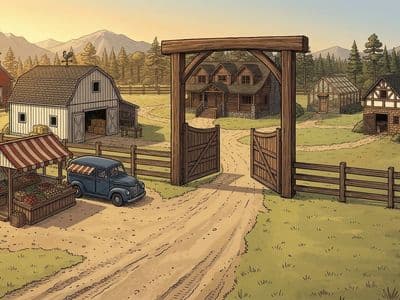
The farmer passes the market stall at the fence line. The Merchant has the counter open, facing the road. Prices, customers, margins. The Merchant knows all three and documents every transaction. The Farmers Market Van is parked beside the stall, loaded for a run to the city. The Merchant sees customers as relationships, not line items. The farmer trusts that instinct, because it is the instinct that brings people back.
Past the fence, the Beekeeper is checking hives. Bees do not respect property lines. They range into the forest, along the roads, into the city gardens, and they return with two things. The first is honey: visitors arriving at the farm with intent. The second is intelligence. Bees that visit distant gardens come back knowing which flowers are blooming, which fields lie fallow, which competitors have new produce at their stalls. The Beekeeper reads both signals. Positioning hives where the richest pollen grows is half the job. The other half is listening to what the swarm reports about the world beyond the fence.
The farmer heads back to the house.
You have just met six archetypes. If you are planning your own AI team, resist the urge to start with the tools. Start with the roles. What does each one own? Where do they work? Who do they talk to when they are stuck? The tooling decisions follow from those answers. I have seen people install five MCP servers and three automation platforms before deciding what their agents are actually responsible for. It goes about as well as hiring six farmhands and letting them sort out who does what on their own.
Why six
The communication pathways in a group follow the formula n(n-1)/2. Six hands give the farmer fifteen pathways. That is the edge of what one person holds in their head during a single standup. Seven hands would be twenty-one. Ten would be forty-five. Dunbar's research puts the core support group at about five. The U.S. Army structures its fire teams around the same number, for reasons where getting it wrong costs more than quarterly earnings.
This farm has six hands because that is where one farmer's attention still covers the full team.
The chain
The hands do not report to each other. They serve each other. No middle management sits between the farmer and the six. The farm runs as a mesh, and the mesh has a natural flow:
Steward → Builder → Groundskeeper → Beekeeper → Merchant → Bookkeeper
The Steward captures the idea and sets the priority. The Builder validates it in the greenhouse. The Groundskeeper takes it to the field and keeps it alive. The Beekeeper brings attention to it. The Merchant sells what the attention produced. The Bookkeeper records what actually happened. When a crop fails, you trace it back to a specific link. Accountability is built into the sequence.
Back upstairs, the farmer looks at the dashboard on the wall. Six hands active. Three fields being worked. Creek level normal. Barn inventory climbing. The barn number again. Something is not keeping pace.
The farmer picks up the walkie-talkie tuned to the Steward's frequency. "The barn is filling up. Can you and the Merchant figure out what's stuck?" The Steward responds in ten seconds. The farmer puts down the walkie-talkie and moves on to the next decision.
That is how the attention equation works. The bell batches communication. The chalkboard shows status without asking. The walkie-talkies get answers without walking. The constitution provides rules without micromanaging. The Bookkeeper delivers summaries without drowning the farmer in raw data. If you build this farm and the farmer is busier than before, something is wrong.
Every one of these mechanisms maps to a real pattern in agentic architecture. The standup is a ceremony. The chalkboard is a task queue. The walkie-talkie is async messaging. The constitution is a governance document that applies even when no human is watching. We will get to all of them. But first you need to understand why every single one of them exists, and that requires seeing what the farmer saw next.
What the farmer saw
Late afternoon. The farmer is on the upper floor, looking out over the fields. The Groundskeeper is in the east field, checking soil. Normal. But then the farmer looks at the west field. The Groundskeeper is there too. Same posture. Same methodical walk between the rows. The same hand, in two fields at once.
The farmer looks at the dashboard. The Builder is logged in the greenhouse. The Builder is also logged at the schoolhouse, reviewing lesson notes. Simultaneously.
The hands on this farm are not ordinary workers. They can be present in multiple fields at the same time. Not by running between them. By being there, fully, in each one. The same knowledge. The same constitution. The same identity. Working five rows simultaneously. Or ten. Or fifty.
Six hands who can each work one field give a farmer six parallel operations. Manageable. Six hands who can each work fifty fields give a farmer three hundred parallel operations. The crops will be tended. But every one of those hands has access to tools. Every one of them can reach the market stall. Every one of them can talk to a customer, send a message down the road, or borrow a key from the cabinet. Multiply that by fifty and think about what happens on a Tuesday afternoon when the farmer is asleep upstairs and a hand in the far field decides to be helpful.
The farmer cannot watch three hundred fields. The farmer can barely watch six. The tools are sharp. The keys open real doors. The road to the city is open.
This farm needs a fence.
Share this article
If you found this useful, connect with me — it takes 10 seconds and helps me know who I'm writing for.
Connect →Recommended