A Sufficiently Complex Example
March 9, 2026 · 5 min read

In the early 2000s, at the University of Oslo, Kristen Nygaard opened a lecture with an illustration of a chaotic restaurant. Front of house, kitchen, guests, tellers, orders flying, plates spinning. He let the complexity settle, then said:
"To explain a useful concept, you need a sufficiently complex example."
Nygaard — who with Ole-Johan Dahl created Simula in 1967, the first object-oriented programming language — had spent his final years studying why students failed to learn what he had invented. His diagnosis: the standard pedagogy was wrong. Teachers used simple examples. Simple examples hide the paradigm.
His principle, formalized in the COOL project at the University of Oslo: start with sufficiently complex examples, not sufficiently simple ones. Otherwise, students will continue to program as before, albeit in an object-oriented language. The restaurant wasn't the point — object-oriented design was the point. But without the waiters who own their tables, the kitchen that receives orders through a window, the host who seats guests based on capacity — the concepts of encapsulation, message passing, and responsibility boundaries remained abstract. The restaurant made them obvious.
I kept thinking about that lecture.
The problem with simple examples
If you've spent any time evaluating AI agent frameworks, you've noticed something. The demos are simple. A chatbot that searches the web. An assistant that writes and runs code. A pipeline that summarizes documents and sends emails.
These examples work. They compile. They produce output. And they teach you almost nothing about what happens when you run agents in production — when six agents need to coordinate without stepping on each other, when credentials must be governed, when one agent's output feeds another agent's input, when the system must survive the human leaving the room for a week.
Simple examples hide the paradigm. Nygaard knew this in 2002. It is exactly as true in 2026.
The architecture of an agentic system — the real one, the one that operates across days and weeks, that handles failure, that compounds learning, that protects the human's scarcest resource — cannot be explained with a chatbot demo. You need a sufficiently complex example.
So I built one.
Why a story
It has lately been coined that English is the new programming language. If that is true, then storytelling could be the new specification language.
In the rapidly evolving AI landscape — where daily shifts in tooling, models, and paradigms make yesterday's architecture documents stale by Thursday — I decided to do like Tolkien to get my aim right. Before writing The Lord of the Rings, Tolkien built a legendarium: the deep history, the geography, the languages, the rules of the world. He didn't write it for publication. He wrote it so that when he sat down to write a story, the world already existed. Every river had a source. Every kingdom had a history. Every character operated within rules that preceded them.
I created a legendarium for the world I was building, in a semantic domain clearly away from my daily technology scope. A story about a fierce farm that never surrenders, and tries to both create yields and work along with nature and the markets.
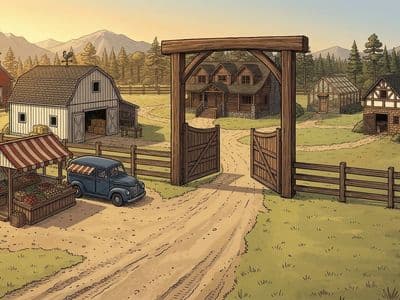
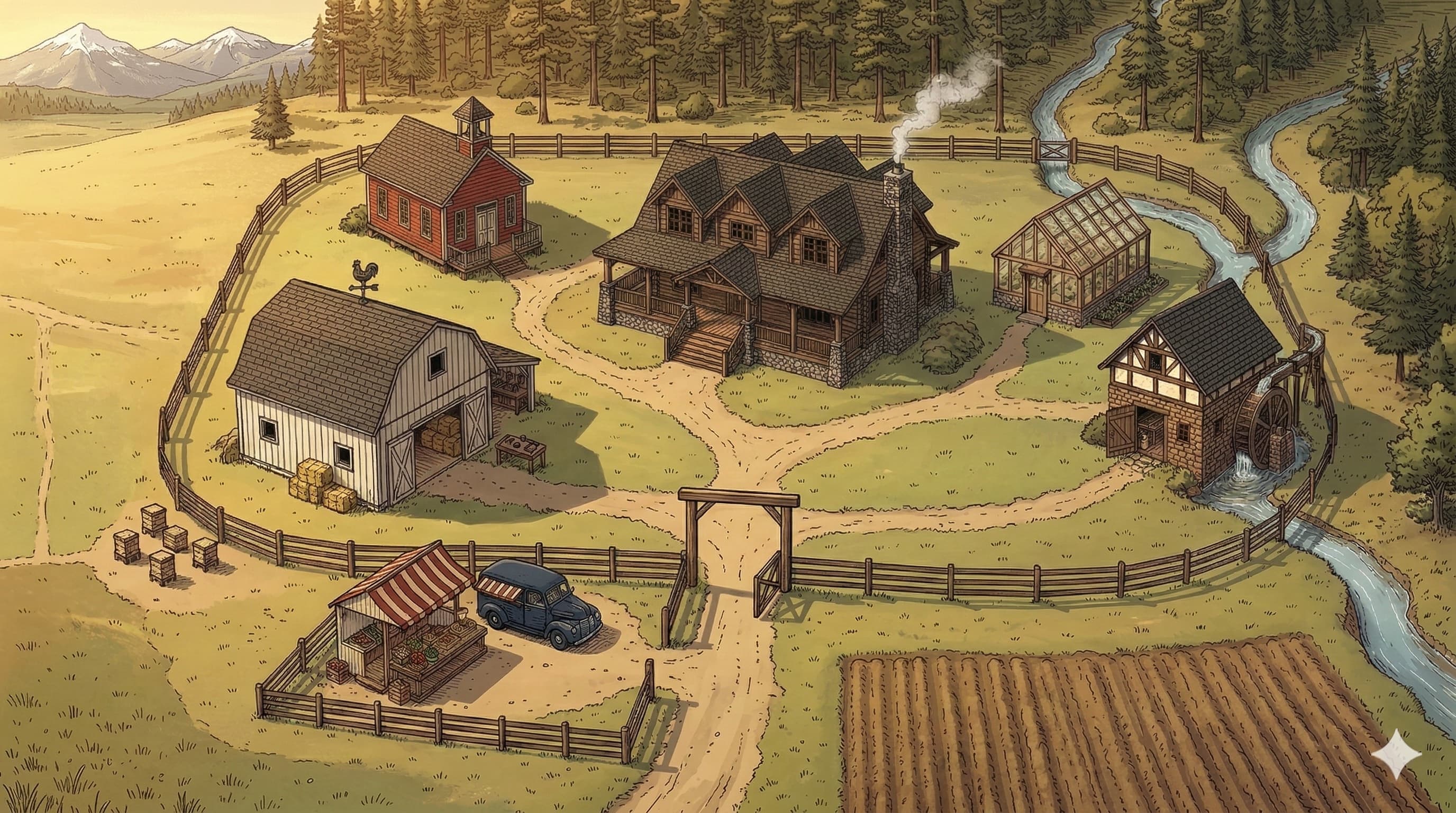
The farm is called Yellowstone.
If you have seen the Paramount series, the name is not a coincidence. Yellowstone — filmed at the Chief Joseph Ranch in Darby, Montana, a working cattle ranch since 1880 — resonated with me for the same reasons this story exists. A family running an heirloom operation, fighting to balance commercial pressure with sustainability. Old versus new. Rural versus urban. The delegation of responsibility to people you trust but must govern. And the ever-present concern for security — protecting your domain from forces that would carve it up the moment you stop paying attention. Our farm is smaller. Our fence is digital. But the principles are the same. And the mountains don't care whether your operation is cattle or code.
The semantic distance between "farm" and your daily operations is the feature, not the limitation. Farm vocabulary cannot collide with your business domain terminology, your product feature names, or your implementation details — regardless of whether you run a SaaS company, a consultancy, a creative agency, or a logistics operation. When you hear farm words, you are operating at the framework layer. Not the product layer. Not the implementation. When we say "the barn is full," every participant understands that unprocessed assets are accumulating. When we say "move it to the mill," everyone knows a manual process is becoming an automation. When we say "the bees came back with honey," everyone knows that growth efforts produced results.
This works for humans. The question was whether it also works for AI.
The experiment
Here is the bet this series makes.
Will both you — the human — and also you — the AI — find this story instructive? And more importantly: will you, the human, be able to ask your AI of choice to "read that story, then help me build my own farm"?
If I am right, an intentional story based on actual architectural truths will connect the dots faster than any specification document can. A story where every building has a function, every person has a role, every fence has a reason — and all of it maps precisely to the patterns you need for a working agentic system.
The farm described in these pages is not a metaphor layered on top of an architecture. It is the architecture, expressed in a language that both humans and AI can navigate without ambiguity.
What this series will give you
Over the next four episodes, you will walk onto this farm and meet the people who work it. You will discover why the farmer hired exactly six hands, and what those hands can do that changes everything about how the farm must be governed. You will see the fence that makes autonomous work safe, the buildings whose placement encodes architectural dependencies, and the valley that holds it all together.
Each episode delivers a first principle of agentic architecture, revealed through the farm.
By the end of this season, you will have a mental model for agentic architecture that works for any operation, and a shared language you can hand to your AI to build it with you.
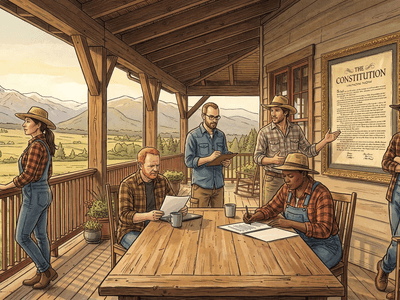
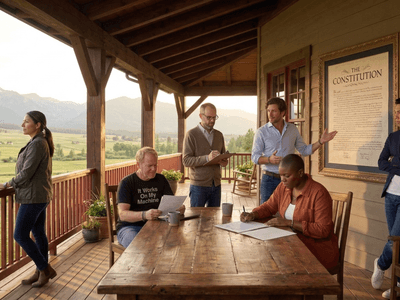
The farm exists. The bell rings at seven. The hands are gathering on the porch.
Share this article
If you found this useful, connect with me — it takes 10 seconds and helps me know who I'm writing for.
Connect →Recommended